
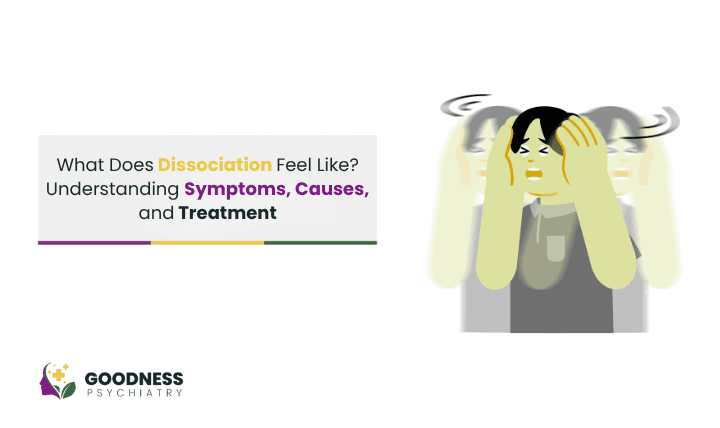
Have you ever experienced that you are distant, watching your life, and there is a glass wall between you and the world? Or does everything around you suddenly seem to become unreal, foggy, or dreamlike? Then, it is possible that you are dissociating.
At Goodness Psychiatry, we get to encounter a lot of individuals who recount that they feel confused and afraid of what is going on with them. What is essential to understand is that dissociation is actually a psychological event, and in most instances, a defensive mechanism of the brain to stress, anxiety, or trauma.
Here we will describe what dissociation is like, the symptoms, the types, its possible causes, and when it might be considered to be a part of a dissociative disorder, which requires professional attention.
What Is Dissociation?
Dissociation is a mental process in which your brain loses contact with thoughts, moods, memories, or who you are.
It is said to be:
- Sensations of alienation from yourself
- A sense of being out of touch with reality
- Experiencing “auto-pilot” moments
Simply put, dissociation is how the brain works to establish emotional distance when something overwhelms.
It is generally related to:
- Anxiety disorders
- PTSD (post-traumatic stress disorder)
- Depression
- Trauma-related conditions
- Dissociative disorders
What Are Dissociative Disorders?
Dissociative disorders are psychiatric conditions in which the occurrence of dissociation is either common, severe, or interferes with normal living.
Dissociative disorders are not like occasional spacing out, but they affect:
- Memory
- Identity
- Awareness of surroundings
- Sense of self
Common types include:
In case of persistent symptoms or disruption of routine functioning, a psychiatric assessment is needed.
The Most Common Types of Dissociation
Dissociation may manifest itself in various forms:
1. Depersonalization
You feel detached from yourself or your body.
You may think:
- “I feel like I’m outside my body.”
- “My voice does not feel like mine.”
- “I feel as though I am watching myself.”
This includes feeling emotionally and physically numb, sensing your body is in a twisted or different shape, and not having control over your body or what you say.
2. Derealization
It is an experience where the external world feels immaterial or unreal.
Common experiences:
- The world is foggy or dreamlike, like a glass wall separating a person from their environment
- Familiar places feel fake or strange
- Sounds/colors are out of place
People with derealization understand that their perceptions are not real.
3. Dissociative Amnesia
Lapses in memory beyond normal forgetfulness. Examples:
- Forgetting conversations or events
- Losing time
- Losing an idea of how you got somewhere
4. Identity Confusion or Alteration
It’s like having a disturbed sense of self. This may include:
- Sensation that there are different versions of yourself present
- Doing things that are not familiar
- Confusion about self-identity
What Does Dissociation Feel Like? (Real Descriptions)
Dissociation is sometimes said to be:
- “I feel that I am floating out of body.”
- “It seems that everything is a movie or simulation.”
- “I feel that I have heard myself talking but not attached to that”
- “Time is distorted or lost.”
- “I am emotionally numb, as though nothing is real.”
Physical symptoms can encompass:
- Dizziness
- Tingling sensations
- Lightheadedness
- Being out of touch with your body
Common Causes and Triggers of Dissociation
Dissociation usually occurs in cases where the brain is overwhelmed.
Common triggers include:
- Stress or anxiety is high
- Reminders of trauma (PTSD-related triggers)
- Emotional overload
- Lack of sleep
- Substance use
- Major life changes
To a great number, dissociation is associated with untreated anxiety, PTSD, or depressive disorders.
When Dissociation Becomes a Problem
Sometimes it is normal to be dissociated when under stress. Nonetheless, it might require professional assistance in case you observe:
- Recurrent or progressive episodes
- Trouble functioning at work or home
- Memory gaps or “lost time.”
- Being out of place during the greater part of the day
- Fear of leaving the house due to symptoms
These can be indications of a trauma-related condition or dissociative disorder.
What Helps During Dissociation? (Grounding Techniques)
The following techniques will be helpful to get you back to the present:
1. 5-4-3-2-1 grounding
Identify:
- 5 things you see
- 4 things you feel
- 3 things you hear
- 2 things you smell
- 1 thing you taste
2. Physical grounding
- Press your feet into the floor
- Hold an object that is cold
- Touch textured surfaces
3. Controlled breathing
Try box breathing:
- Inhale 4 seconds
- Hold 4 seconds
- Exhale 4 seconds
- Hold 4 seconds
4. Movement techniques
- Walk slowly
- Stretch your body
- Speak out loud what you are doing
How Goodness Psychiatry Can Help
At Goodness Psychiatry, we offer evidence-based, caring services for dissociation and related disorders. Our approach includes:
Mental health evaluation
To understand whether symptoms are related to trauma, anxiety, depression, or a dissociative disorder.
Medication management
To assist in stabilizing mood, anxiety, and lessening symptom severity, as required.
Supportive psychotherapy
To work through underlying trauma and reconstruct a stable sense of self.
Oral ketamine treatment (when appropriate)
May assist patients with emotional numbness, depression, or symptoms associated with trauma.
We provide face-to-face services in the DFW community and telepsychiatry in the state of Texas.
You Don’t Have to Go Through This Alone
Dissociation is a confusing and isolating experience; nonetheless, it is manageable, and most affected individuals recover with the appropriate support.
In case you can identify with the symptoms, seeking assistance is a good and powerful action.
Early intervention can make a big difference in recovery.
Take the Next Step
In case you are dissociating or have other symptoms, you can make an appointment with Goodness Psychiatry to have a confidential psychiatric assessment.
FAQs
How does dissociation feel like?
Dissociation may seem like not belonging to yourself or to the world, as though you are an observer of life, or that nothing is real.
Is dissociation normal?
Sometimes dissociation may occur as a stress response; however, when it becomes frequent, a professional assessment may be required.
What causes dissociation?
It is often caused by stress, trauma, anxiety, or PTSD-related triggers.
When should I seek help?
If dissociation happens often or affects daily life, it’s best to consult a psychiatrist.
